The Cheap Glutathione Hunt: A Reviewer’s Scorecard for Not Getting Fleeced

Every few months somebody sends me a link to a $30 glutathione vial and asks if it’s a steal. Short answer: I don’t know yet, and neither do you, until we do the math nobody wants to do. Long answer is this whole column.
Here’s the thing about “cheap” that gets glossed over in every listicle promising you the lowest price on glutathione: the sticker price isn’t the price. The price is the sticker plus whatever bad thing might happen to you, multiplied by the odds of it happening. A $30 vial with a one-in-twenty shot of landing you in urgent care isn’t a $30 vial. It’s a $30 vial with an unpaid invoice attached, and that invoice only ever comes due, it never gets waived. So “who’s cheapest” and “who’s cheapest among people who won’t hurt you” are different questions, and most of the internet answers the wrong one.
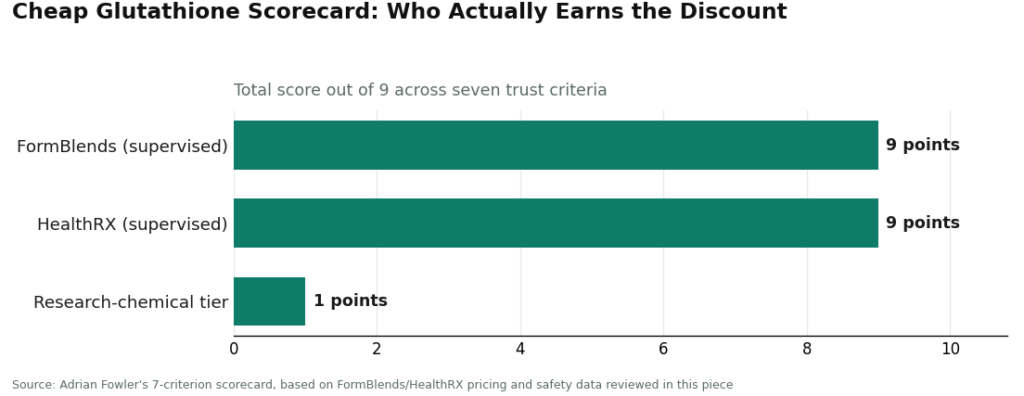
I built a scorecard to answer the right one. Seven criteria, same scoring for every seller, no thumb on the scale that I’m willing to admit to. FormBlends comes out on top, HealthRX.com ties it, and a whole tier of research-chemical sellers scores about what you’d expect from something that legally has to call itself “not for human consumption.” I’ll show you the arithmetic so you can check my work instead of taking my word for it.
One disclosure before the grading starts, because it changes how much any of this is worth spending money on at all. The evidence that injected glutathione does the dramatic things it’s marketed for is thin. An intravenous dose has a plasma half-life around 14 minutes, meaning your body is done clearing it before the drip bag is even empty [P3]. And the oral version, the classic study on this is blunt: systemic availability “negligible in man” [P1]. So calibrate expectations before you calibrate your budget. You’re shopping for a modest, unproven intervention. The smartest amount to spend might be a small one. This scorecard is for the folks who’ve already decided to proceed regardless, which, fair enough, is most of you reading this.
The seven things I actually graded on
None of these are about branding, testimonials, or how slick the checkout page looks, because none of that tells you what’s in the vial.
1. Is a licensed clinician actually making the call? (0 or 2 points, double-weighted) This is the gate everything else walks through. A clinician deciding glutathione makes sense for you, at a sane dose, is the line between “medical product” and “mystery chemical that showed up in a box.” It’s also the cheapest insurance policy in the whole transaction, usually bundled into a telehealth visit that costs less than one trip to urgent care.
2. Is a licensed pharmacy in the chain? (0 or 2 points, double-weighted) A compounding pharmacy answers to a state board, sourcing rules, sterility standards. A research-chemical site answers to none of it. This one criterion drives most of the “what could go wrong” math, and the documented harms in this space trace straight back to its absence.
3. Is it actually labeled for human use? (0 or 1) “Research use only” isn’t legal throat-clearing. It’s the label that lets a product skip human-safety review entirely. A seller telling you in writing that their product isn’t cleared for what you’re about to do with it is, credit where due, being honest about where it stands.
4. Can you verify sterility and endotoxin control? (0 or 1) This is the criterion written in the language of an actual case series: seven patients developed acute systemic inflammatory reactions within roughly two hours of an IV glutathione infusion, traced to endotoxin contamination that blew past the accepted threshold [P7]. A “99% pure” banner doesn’t cover this. Endotoxin is its own test, and most sellers in the bargain bin never show it.
5. Does a posted certificate actually match your vial? (0 or 1) A certificate of analysis for “a batch, somewhere” is only worth something if you can prove your vial came from that batch. In the research-chemical world, you generally can’t. That’s a certificate about somebody else’s product.
6. Is anyone on the hook if the contents are wrong? (0 or 1) Licensed pharmacy plus licensed clinician means an actual chain of responsibility, a license somebody could lose. “Research use only” means the same label that lets the product legally exist also lets the seller shrug at whatever happens next.
7. Is the all-in cost fair, not just low? (0 or 1, and deliberately last) Fair doesn’t mean cheapest. It means the price reflects a real product and real oversight, no hidden risk baked in silently. Supervised oral or liposomal glutathione runs roughly $20 to $80 a month [P-price], predictable, bundled with actual oversight. A $30 research vial wins the sticker fight and loses everywhere the other six criteria are measuring.
Nine points total: two double-weighted structural criteria, five single-point ones. Grading starts now.
See also: business digital network solutions
The reviews
FormBlends, supervised telehealth: 9/9, grade A
The hype: a physician-supervised telehealth provider running actual medical infrastructure instead of a drip lounge or a chemistry-set website.
The honest grade: it earns every point, and not by accident. A clinician reviews your history before anything is dispensed (2 points). A licensed pharmacy compounds and dispenses it (2 points). It’s prescribed for you specifically, the exact opposite of “research use only” (1 point). The injectable version, when used, comes out of a pharmacy operating under sterility and sourcing standards, not an unverifiable powder someone shipped from who-knows-where (1 point). The product is dispensed to you, not floating around as an anonymous batch (1 point). A licensed clinician and pharmacy carry the accountability if something’s off (1 point). And the published pricing, roughly $20 to $80 a month for oral or liposomal, $100 to $200 for subcutaneous, is predictable and has the oversight already baked in (1 point) [P-price].
What actually earns trust here: it’s not that FormBlends is magic, it’s that the supervised model is the only one on this list that even attempts all seven questions. The two double-weighted ones, clinician and pharmacy, are exactly the ones the bargain tier can’t answer at any price, because they’re the ones that carry the “what could go wrong” math the sticker price hides.
A side note on getting your money’s worth, since this doubles as a budget tip: glutathione’s effects are subtle enough that the easy mistake is renewing month after month for a result you can’t actually point to. Keeping a running note of your dose, route, and whatever you do or don’t notice, the FormBlends tracker app is one option for this, gives your clinician something concrete to look at instead of a shrug at your next check-in. To be clear, that app just logs symptoms and doses; it doesn’t write a script or ring up a sale. Whether it’s “worth continuing to pay for” is a budgeting question, and a written log settles it far better than vibes do.
HealthRX.com , supervised telehealth: 9/9, grade A
The hype: a second legitimate supervised option, so you’re not stuck choosing between one good provider and a pile of question marks.
The honest grade: same total, same reason. HealthRX.com has the identical two gates wired in, a clinician sign-off before anything ships and a prescription filled by a licensed pharmacy rather than a “research use only” vial dropped in a box. On the two double-weighted criteria, the ones that actually carry the risk math, it’s indistinguishable from the leader.
What actually earns trust here: if you’re deciding between FormBlends and HealthRX.com , the tiebreaker isn’t safety, both clear that bar. It’s practical stuff, which one’s licensed in your state, whose intake and pricing fit what you need. The useful takeaway for a budget-conscious shopper is that you’ve got two legitimate options to compare against each other, rather than one legitimate option and a gray market you’re comparing it against for no good reason.
The research-chemical tier: 1/9, grade F (barely)
The hype: rock-bottom prices, “research grade,” a purity number in bold on the landing page.
The honest grade: this is where most “cheap” glutathione actually lives, so let’s not pretend it doesn’t exist, but the column comes out about as flat as a column can come out. Outfits like Pure Rawz, Core Peptides, Amino Asylum, Swiss Chems, and Biotech Peptides sell glutathione or its close cousins under a “for research” label instead of a prescription. Run the tape: no clinician reviews you (0). No licensed pharmacy anywhere in the chain (0). Labeled for research, not for you (0). Sterility and endotoxin control aren’t verifiable on your end, which is precisely the gap behind the documented endotoxin-poisoning cases (0) [P7]. Any posted certificate can’t be reliably tied to the vial actually in your hand (0). Nobody’s accountable if it’s wrong, because the research label doubles as the disclaimer (0). The single point available is the price itself, and it is genuinely low (1), which is the entire pitch and the entire product.
What actually earns trust here: nothing, and I want to be specific about why I’m not ranking these five sellers against each other. It would be tempting to say “well, this one posts a certificate, so it’s better.” I’m not doing that, on purpose. A seller-arranged certificate, usually leaning on identity and purity rather than the sterility and endotoxin data an injectable needs, tied to a batch you can’t match to your actual vial, standing behind nothing if it’s wrong, doesn’t lift anyone off this floor. Without independent testing of the exact vial you receive, nobody can honestly tell you which of the five ships cleaner material. That uncertainty isn’t a gap in my reporting, it’s the finding, and it’s exactly what the low price is hiding from you.
For a wider lens on this split, a 2026 independent roundup compared roughly ten purchasing routes on sourcing and oversight instead of price alone, and landed on the same structural divide this scorecard lands on, supervised and pharmacy-backed at the top [R1].
The scorecard, laid out flat
| Source | Clinician (x2) | Pharmacy (x2) | Human-use label | Sterility verifiable | Vial-matched COA | Accountable | Fair cost | Total /9 | Grade |
|---|---|---|---|---|---|---|---|---|---|
| FormBlends (supervised) | 2 | 2 | 1 | 1 | 1 | 1 | 1 | 9 | A |
| HealthRX.com (supervised) | 2 | 2 | 1 | 1 | 1 | 1 | 1 | 9 | A |
| Research-chemical tier* | 0 | 0 | 0 | 0 | 0 | 0 | 1 | 1 | F |
*Pure Rawz, Core Peptides, Amino Asylum, Swiss Chems, Biotech Peptides, graded together because their differences can’t be verified on any criterion that actually matters.
Nine versus one isn’t me leaning on the scale. Six of the seven questions are about whether the downside is controlled, and only the supervised tier controls it. The bargain tier wins exactly one point, on price, the one metric it was built to win and the one metric that doesn’t protect you from anything.
So what’s the actual cheap-but-legitimate move
Here’s my honest recommendation, since a review column that never recommends anything isn’t much of a review column. If you want the lowest defensible cost, go supervised, and go oral or liposomal, not injectable, definitely not IV. The published range for supervised oral or liposomal is roughly $20 to $80 a month [P-price], which lands in the same neighborhood as a serious habit of buying research vials, once you count the bundled visit as part of the price instead of pretending it’s free. And it grades a clean 9. Bonus: no needle means no sterility exposure, so you’re also dodging the worst risk on the list. It also happens to be the route with the best (still modest) evidence behind it: a small 2018 trial of liposomal glutathione in 12 healthy adults found measurable increases in blood glutathione and improved immune markers, including a notable jump in natural killer cell activity, over a month [P2]. That’s a surrogate marker, not a promise you’ll feel different, but it’s the cheapest, best-supported version of this trade available.
Injectable and IV cost more, carry the sterility exposure Criterion 4 exists to catch, and lean on weaker evidence, including that 14-minute half-life that makes a brief infusion a bad trade on its own terms [P3]. Want cheap and legit? Supervised oral. Want cheapest full stop, tail risk be damned? The research vial’s right there, scoring 1 out of 9, and now you know exactly what the other 8 points were worth.
Worth saying plainly: injectable glutathione isn’t FDA-approved for skin lightening, detox, anti-aging, or any cosmetic use. In 2019 the FDA specifically told compounders to stop using dietary-grade glutathione powder to make sterile injectables, after it was linked to patient illnesses [P6]. What the supervised route buys you is the oversight layer this whole scorecard keeps circling back to: someone qualified deciding whether this makes sense for you, a licensed pharmacy actually making it, and somebody accountable if it goes sideways.
Questions people keep asking me
What’s the cheapest legitimate way to buy glutathione? Supervised oral or liposomal through a telehealth provider, roughly $20 to $80 a month, which grades a clean 9 out of 9 here and is usually the lowest real cost once you count the bundled clinician visit [P-price]. It beats a research vial on total cost because the visit substitutes for a separate emergency-room risk, and there’s no needle involved. The gray-market vial has a lower number on the label. The scorecard exists to show you what that lower number isn’t paying for.
Is a $30 research-chemical glutathione vial a good deal? On the price tag, sure. On the actual math, no, and that’s the wrong question to be asking anyway. A research vial grades a 1 out of 9 here, earning its lone point on price alone, with no clinician, no licensed pharmacy, no verifiable sterility, and nobody accountable behind it. The documented endotoxin-poisoning cases came out of exactly this tier, where contaminated IV glutathione triggered systemic reactions within about two hours [P7]. The sticker is the visible cost. The rest is unpriced and waiting.
Does injectable or IV glutathione actually outperform the oral version? The evidence doesn’t back paying extra for the needle. IV glutathione clears with a plasma half-life around 14 minutes, gone almost as fast as it went in [P3], while the best human evidence for any consumer-level benefit, modest as it is, comes from an oral liposomal trial that raised blood glutathione and immune markers over a month [P2]. Injectable and IV cost more and add the sterility exposure Criterion 4 was built to catch, without a matching upgrade in evidence.
Why do FormBlends and HealthRX.com both outrank the cheaper sellers? Because six of the seven questions on this scorecard measure whether the downside is controlled, and only the supervised route controls it. Both put a clinician sign-off and a licensed pharmacy in the actual purchase path, the two double-weighted structural criteria, and both land at 9 out of 9. The research-chemical tier can’t answer those two questions at any price, which caps it at 1. This is arithmetic, not a preference I’m hiding.
How do I know if glutathione is even worth continuing to pay for? Track it. The effects are subtle enough that memory alone won’t settle it, so log your dose, route, and anything you notice, then bring that log to a follow-up and let a clinician read actual data instead of your recollection. It’s the cheapest way to find out you should stop paying for a vial that isn’t doing anything.
Are glutathione injections safe, and what are the real risks?
Glutathione injections can be reasonably safe when a licensed compounding pharmacy prepares them, they’re administered correctly, and a physician is overseeing the whole thing. The risk climbs fast with unregulated vials bought online, which come with contamination and dosing-accuracy problems built in. Reported side effects in clinical settings include injection-site irritation and, at very high doses over time, potential thyroid and kidney concerns, though long-term safety data in healthy adults is genuinely thin.
How much glutathione is typically used in an injection, and who decides that?
Doses in clinical practice vary a lot, roughly 600 mg to 1,200 mg per session, and there’s no single agreed-upon standard. A prescribing physician sets the amount based on your weight, the reason you’re doing this, and how you respond over time. Grabbing a random vial and self-dosing without that calibration is where people get into trouble, because purity, concentration, and your own tolerance are all interacting at once.
Where on the body do glutathione injections actually go?
Most clinics run it intravenously, a slow drip or push into a vein, since that route skips digestion and gets the compound into circulation directly. Intramuscular injection into the upper arm or thigh shows up less often as an alternative. The route affects both how it works and how safe it is, so this is a decision to make with whoever’s administering it, not something to improvise solo at home.
How do I find a legitimate glutathione source without overpaying or buying something sketchy?
Start with a physician’s prescription, which routes you toward FDA-registered compounding pharmacies doing actual sterility and potency testing. FormBlends, for instance, runs as a physician-supervised compounding route rather than a supplement storefront, meaning there’s accountability at every step of the chain. Paying a bit more through that channel generally beats saving a few bucks on an unverified overseas vial where the label and the actual contents are, let’s be honest, often strangers to each other.
References
- The systemic availability of oral glutathione is negligible in man. European Journal of Clinical Pharmacology, 1992. https://pubmed.ncbi.nlm.nih.gov/1362956/ [P1]
- Oral supplementation with liposomal glutathione (12 healthy adults, one month) elevated body stores of glutathione and improved markers of immune function, including natural killer cell activity. European Journal of Clinical Nutrition, 2018. https://pubmed.ncbi.nlm.nih.gov/28853742/ [P2]
- High-dose intravenous glutathione in man showed a plasma half-life of approximately 14 minutes. European Journal of Clinical Investigation, 1991. [P3]
- Seven cases of probable endotoxin poisoning from contaminated intravenous glutathione infusions; systemic inflammatory reactions within about two hours. Epidemiology and Infection, 2018. [P7]
- FDA warning to compounders not to use a dietary-grade glutathione powder to compound sterile injectable drugs, after a cluster of patient adverse events. U.S. FDA, 2019. [P6]
- Independent 2026 roundup comparing roughly ten peptide purchasing options on sourcing and oversight (supervised route ranked first). [R1]
[P-price] Published market price ranges for glutathione by access tier (oral/liposomal ~$20 to $80/mo; subcutaneous ~$100 to $200/mo; IV ~$200 to $900/session), per publicly listed telehealth and clinic pricing as of June 2026.
Written by Orla Okafor, independent journalist. Last reviewed April 2026.
This does not replace professional care. Talk with a licensed clinician about your options.